Menorca from the water: seven anchorages for a perfect day
Many of Menorca's finest coves can only be reached on foot or by boat. Seven anchorages worth the trip – and why the wind decides which one it will be. Article text:
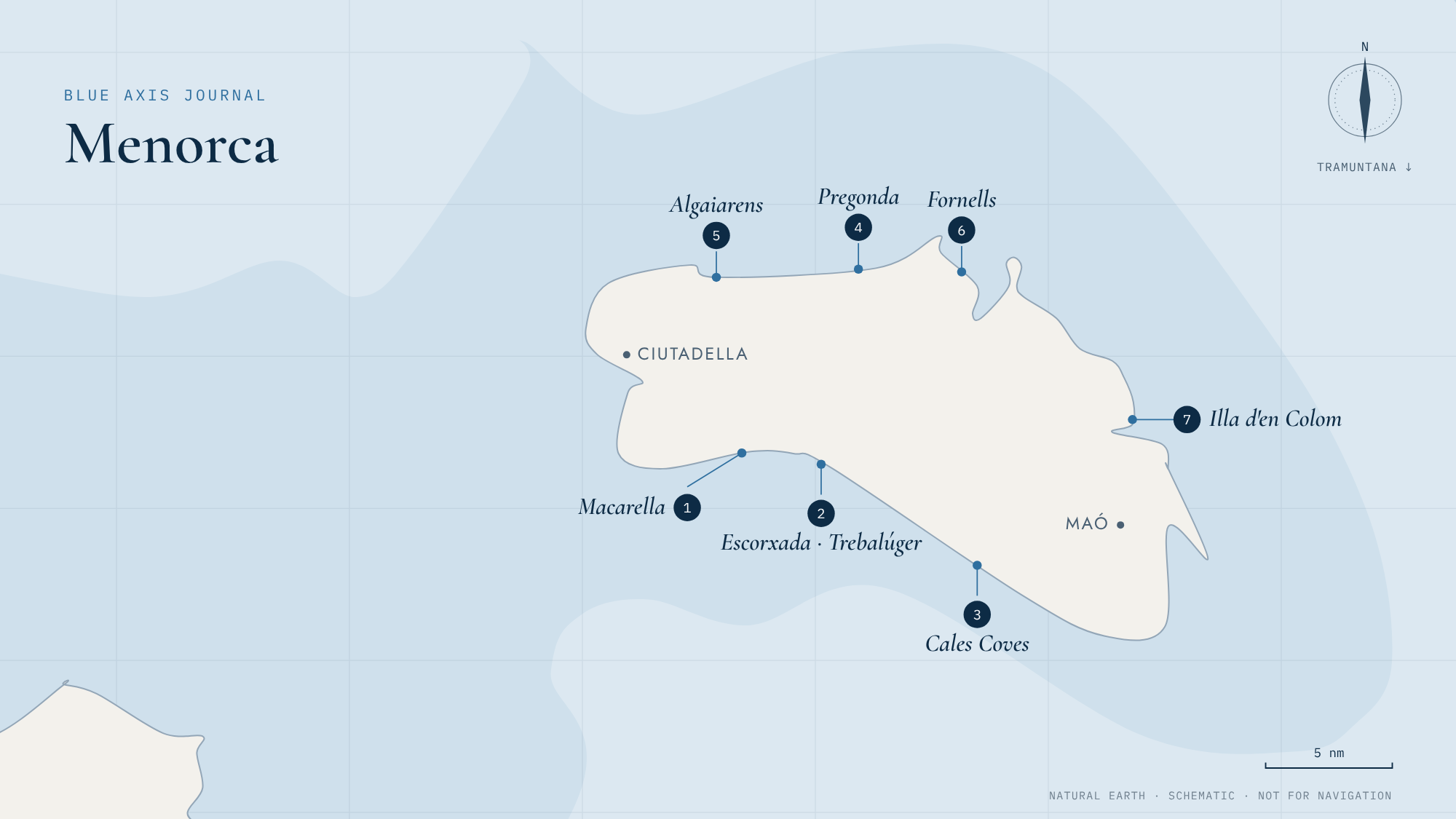
Menorca is the quietest of the large Balearic Islands. The whole island has been a UNESCO Biosphere Reserve since 1993, and much of its coastline is undeveloped. Many of the best known coves can only be reached via the Camí de Cavalls coastal path or from the sea. Arrive by yacht and you drop anchor where others walk an hour through the pine woods.
Ask the wind first
On Menorca, the wind decides which coast is right for the day. When the Tramuntana blows from the north, the north coast gets rough and the south is sheltered. With a southerly wind it is the other way round. That is why the captain picks the cove in the morning and why every one of our voyages has a spare day.
The south coast: pale sand, turquoise water
Cala Macarella and Cala Macarelleta. These two neighbouring coves in the south-west are the island’s postcard view: pale sand, pines down to the water, rocks on both sides. In summer they are busy during the day. They are at their best early in the morning or late in the afternoon, once the day visitors have gone.
Cala Escorxada and Cala Trebalúger. Between Cala Galdana and Binigaus lies a stretch of coast without roads. Escorxada is a quiet cove framed by pines, with a sandy bottom at about four metres and crystal clear water. Cala Trebalúger lies right next to it. Neither is recommended when the wind is from the south or south-west.
Cales Coves. The cliffs of this narrow inlet hold around 100 caves, carved into the rock in prehistoric times. You anchor on sand at about three metres, enclosed by cliffs one of the most unusual places on the island to spend a night at anchor.
The north coast: rugged, red, remote
Cala Pregonda. Reddish sand, dark rocks and small islets just offshore: Pregonda looks nothing like the coves of the south. Ideal on days with a southerly wind.
Algaiarens. This wide bay in the north-west has two beaches, Es Tancat and Es Bot, surrounded by pines. The bottom is sand with some patches of weed. It is open to the north when the Tramuntana blows, head somewhere else.
Fornells. This deep, sheltered bay on the north coast ends in a small fishing village. It is known for caldereta de langosta, the spiny lobster stew considered Menorca’s most famous dish.
In the east: Illa d’en Colom
This island off the east coast is part of the S’Albufera des Grau Natural Park. It has two small coves and a large sandy area for anchoring, well sheltered from the prevailing winds. Many consider its waters the best snorkelling on Menorca.
Anchoring with care: the posidonia
Under the water around the Balearics grow large meadows of Neptune grass (Posidonia oceanica). They hold the sand in place and are a key reason the water is so clear. An anchor tears furrows 40 to 50 centimetres wide, and the plant grows back only very slowly.
That is why a dedicated decree has protected the seagrass meadows since 2018. Yachts anchor only on sand the pale turquoise patches between the dark green. In summer, boats from the posidonia watch patrol the coast and ask yachts to re-anchor where needed. Between 2020 and 2024 they checked almost 590,000 anchors; around 7 percent had to be moved. For our guests this means: the crew knows where the sand is, and you enjoy the cove with a clear conscience.
Menorca with Blue Axis
Our voyage “Balearics: culture & cuisine” takes seven nights from Ibiza via Formentera, Cabrera, Palma, Sóller and Pollença to Ciutadella on Menorca, ending with Talayotic sites and Mahón cheese. If you would like to add an extra day at anchor on Menorca’s coast, we plan it with you. Which cove it will be, the wind decides in the morning.